
Motorcycle Stopping distance
This is the distance your motorcycle travels from the moment you realise you must brake to the moment your machine stops.
Always ride so that you can stop safely within the distance you can see to be clear.
Stopping distance depends on
- How fast you’re going
- Whether you’re travelling uphill, on the level or downhill
- Health
- Time of day
- Alcohol or drugs
Stopping distance divides into ‘thinking distance’ and braking distance.
Thinking distance is from the point where you see the hazard to the point where you brake. This distance will vary from rider to rider according to their reaction times.
An alert and fit rider needs 0.75 of a second thinking time. That means that at 50 mph you’ll travel 15 metres (about 50 feet) before you begin to brake.
The following stopping distance chart shows typical CAR stopping distances. The Highway Code points out that a motorcyclist should increase these distances
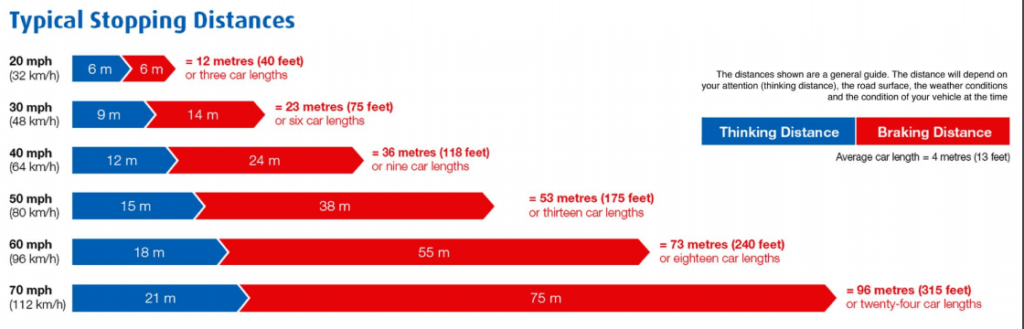
Source – Highway Code
For further information on motorcycle stopping distances, see the following resources: (the first one is particularly good)
- What is the most effective way to bring a motorbike to a complete halt?
- Motorcycle braking:15 questions and answers
- High-siding and low-siding
Motorcycle Braking distance
‘Braking distance’ is from the point where you begin to brake to the point where you stop.
Braking distance depends upon
- Road conditions
- Tyre condition
- Brake efficiency
- Suspension efficiency
- Load. It takes longer to stop if you’re carrying a passenger
- Rider ability
Most of all, braking distance varies with speed. At 30 mph your braking distance will be 14 metres (about 45 feet) while at 70 mph that distance will increase to 75 metres (about 245 feet). That’s just over double the speed but more than five times the braking distance.
How to Brake
Many motorcycle riders are, quite wrongly, afraid to use the front brake. This is usually because of what they learnt as cyclists. On a motorcycle
- You must normally use both brakes
- The front brake is the more powerful of the two brakes and the most important when stopping a motorcycle
To stop most effectively in good road and weather conditions
- Apply the front brake a fraction of a second before you apply the rear brake
- Apply greater pressure to the front brake
Applying greater pressure to the front brake gives the best stopping power in good conditions because
- The combined weight of the machine and rider is thrown forward
- The front tyre is pressed more firmly on the road, giving a better grip
In wet or slippery conditions you need to apply a more equal pressure to both front and rear brakes
It takes much longer to stop by using only one brake. But at very low speeds (walking pace) using only the rear brake gives smoother control.
When to brake
Always look and plan well ahead to avoid having to brake sharply. A gradual increase of pressure on the brakes is better than late, harsh braking.
Follow these rules
- Brake when your machine is upright and moving in a straight line
- Brake in good time
- Adjust the pressure on the brakes according to the road surface and weather conditions
Where to brake
Where you brake is very important. The best time to brake is when you’re travelling in a straight line and your machine is upright. A good rider will plan well ahead to avoid braking in a bend. In a bend the combined weight of motorcycle and rider is thrown outwards. To balance this the rider leans inwards slightly.
If you brake in a bend
- The weight will be thrown outwards even more
- The motorcycle and rider may become unstable
- The tyres may lose their grip on the road surface
If you must brake in a bend
- Avoid using the front brake. Rely on the rear brake and engine braking to slow you down. If you must use the front brake, be very gentle. There’s a risk of the front tyre losing its grip and sliding sideways
- Try to bring your motorcycle upright and brake normally ( provided you can do so safely )
Emergency Braking

If you plan ahead you should seldom need to brake violently or stop suddenly. But sometimes emergencies do arise and you must be able to stop quickly and safely.
Maximum braking
- Keep your motorcycle upright
- Apply maximum effort without locking the wheels. This is achieved by progressively increasing braking pressure. Don’t use the brakes violently – this may cause you to skid
- Use the front brake just before the rear
- Apply the right amount of braking effort to each wheel. This will depend on the road surface and weather conditions
- Pull in the clutch lever just before you stop
Skids
Dealing with skids when braking
If you’ve caused a skid by braking
- Ease off the brakes to let the wheels start turning again
- Re-apply the brakes as firmly as the conditions will permit
Your natural instincts when dealing with a brake skid will be to brake even harder. You must learn to overcome such instincts if you’re to regain control.
Correcting a skid
- Steer into the skid. If the machine is sliding to the right, steer to the right. If the machine is sliding to the left, steer to the left.
- Keep your feet on the footrests. Putting your feet to the ground on a moving motorcycle could upset your balance
Skids are a lot easier to get into than they are to get out of. Remember, skid control is an emergency measure – it’s no substitute for skid avoidance.
Signalling when you brake
Don’t try to give an arm signal when you brake in an emergency
- You’ll need both hands on the handlebars
- Your stop lamp will warn traffic behind you
Next Section >> Indicating and Observation.